|
|
ACG | Policy and Practice News |
|
|
|
|
|
Highlights from this edition include:
-
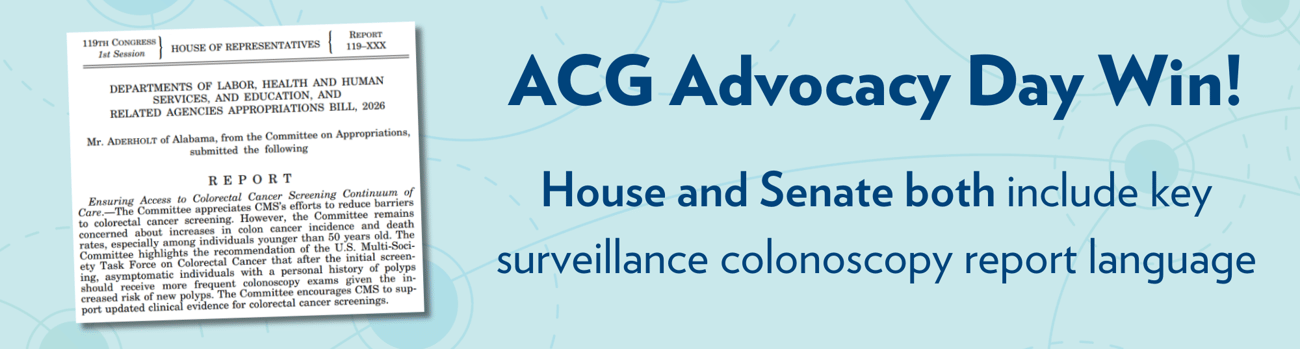
Surveillance colonoscopy update: In a win for ACG's Advocacy Day efforts, the House Appropriations Committee joined their Senate colleagues and included report language encouraging HHS to address the issue.
-
The deadline for Congress to pass a government funding bill is Sept. 30 – we preview the key healthcare issues at stake, including telehealth, NIH funding, and ACA tax credits.
-
In case you missed it: ACG proudly endorses new screening and awareness bills for colorectal and stomach cancer. Get involved and urge your House Representative to support them!
|
|
|
|
|
House and Senate Urge Surveillance Colonoscopy Action |
|
|
|
|
|
Last week, the House Appropriations Committee released its 2025 funding bill for the Department of Health and Human Services (HHS). Like their colleagues in the Senate, the House bill includes a specific section addressing the colorectal cancer (CRC) screening continuum and the importance of surveillance colonoscopy!
ACG Advocacy Day attendees successfully pushed for the committee to include this language, which is designed to inform HHS' priorities for the coming year. This achievement would not have been possible without the efforts of countless ACG leaders who joined us in D.C. this spring.
We are grateful that both chambers of Congress share our concern about the alarming rise in CRC incidence and death rates among young Americans. Looking ahead, ACG is focused on ensuring this language remains in the final funding bills passed by the House and Senate (which may come sometime later this year – more on that below).
As we continue our work with allies in Congress, the core ask remains unchanged: HHS must instruct insurers to cover surveillance colonoscopy as the preventive service it is, with no cost-sharing for patients. |
|
|
|
|
Government Funding Deadline & Appropriations Season:
What You Need to Know |
|
|
|
Congress has until Sept. 30th to pass a funding bill and avert a government shutdown.
Yesterday, the House approved a plan largely on a party-line vote to temporarily extend government funding at current levels into November. However, the bill was quickly rejected in the Senate, leaving Congress stuck at an impasse before the end of the month.
ACG will continue to keep members updated about any potential government shutdown. As a reminder, Medicare claims are generally still processed and paid during a shutdown, but payments may be delayed.
Here's what else you should know, issue by issue: |
|
|
|
Telehealth extension
The House bill includes language to temporarily extend Medicare coverage of telehealth services until November 21.
Ensuring patients have access to GI services through telehealth remains a key ACG public policy priority. In the coming months, we will continue to urge Congress to adopt a multi-year or permanent extension of telehealth coverage. |
|
|
|
NIH funding
Throughout 2025, ACG has heard member concerns over proposed National Institutes of Health (NIH) funding cuts and delays. In more than 20 letters to key Senators and House Representatives, the ACG Governors emphasized the importance of biomedical research, both for our patients and the economies of states and local communities.
If passed, the House's short-term funding bill would keep current NIH funding stable into November. Importantly, this would also provide us additional time to push Congress to adopt the Senate's FY2026 funding plans, which call for a $400 million increase to the NIH's budget and rejects the Trump Administration's proposed 15% cap on indirect costs. |
|
|
|
Affordable Care Act enhanced tax credits
The enhanced tax credits for ACA marketplace premiums that passed in the 2021 COVID-19 relief package are set to expire on Dec. 31st, unless Congress acts.
To secure their votes, Senate Democrats are expected to demand an extension of these premium tax credits be included in a government funding package; some Republicans in both the House and Senate appear open to at least a temporary extension.
If the enhanced credits expire, the Congressional Budget Office expects 4 million Americans will drop their ACA insurance plans. According to a KFF analysis, insurance premiums in 2026 are expected to rise by more than 75%. Of note, KFF also estimates that roughly 90% of the total growth in the ACA marketplaces since 2020 have come from states that voted for President Trump in the 2024 election. |
|
|